
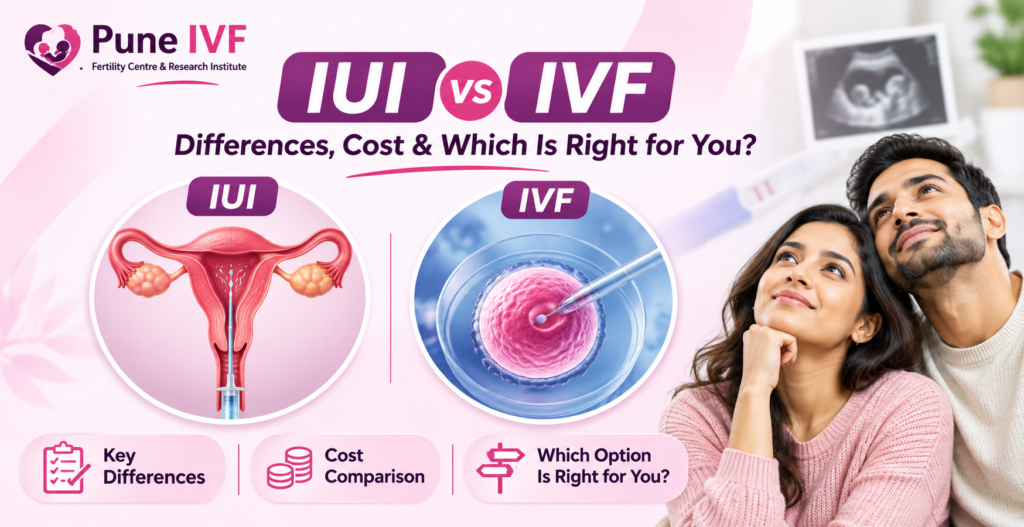
IUI vs IVF: Differences, Success Factors, Cost and Which One to Choose
When you start fertility treatment, two names come up again and again: IUI and IVF. Both help couples conceive, but they work very differently, suit different situations, and differ in cost and in the chances of success per cycle.
Choosing the right one, at the right time, can save you months of waiting and unnecessary expense. This guide explains how IUI and IVF work, who each treatment suits, and how fertility specialists decide which one to recommend.
Quick answer: IUI places specially prepared sperm directly into the uterus around ovulation, so fertilisation still happens naturally inside the body. It is simpler and less expensive, and it suits couples with mild fertility issues. IVF fertilises eggs with sperm in a laboratory and transfers the embryo into the uterus. It is more involved and more expensive, but it offers higher chances per cycle and is often the right choice for blocked tubes, low egg reserve, severe male factor infertility, older age or repeated IUI failure.
| Feature | IUI (Intrauterine Insemination) | IVF (In Vitro Fertilisation) |
|---|---|---|
| How it works | Prepared sperm placed in the uterus around ovulation | Eggs and sperm combined in a lab; embryo transferred to the uterus |
| Where fertilisation happens | Inside the body (fallopian tube) | In the laboratory |
| Medicines | None or mild ovulation-inducing medicines | Daily hormone injections for about 10–12 days |
| Egg retrieval | Not needed | Needed, under short anaesthesia |
| Open fallopian tubes needed | Yes, at least one | No |
| Time per cycle | About 2 weeks of monitoring | About 4–6 weeks including stimulation and transfer |
| Chance of pregnancy per cycle | Lower | Higher |
| Cost per cycle | Lower | Higher |
| Best for | Mild male factor, ovulation problems, unexplained infertility | Blocked tubes, low AMH, severe male factor, age 38+, failed IUIs |
What Is IUI?
IUI (Intrauterine Insemination), sometimes called artificial insemination, gives sperm a head start by placing them directly inside the uterus, closer to the egg.
How IUI works, step by step
- Monitoring the cycle: ultrasound scans track the growth of the egg follicle. Mild medicines may be given to help ovulation.
- Trigger injection: when the follicle is ready, an injection may be given to time ovulation.
- Sperm preparation: a semen sample is “washed” in the lab to select healthy, moving sperm.
- Insemination: the prepared sperm is placed in the uterus with a thin, soft tube. It takes a few minutes and feels similar to a routine pelvic examination.
- Two-week wait: a pregnancy test is done about 2 weeks later.
IUI does not need anaesthesia, and you can return to normal activities the same day.
What Is IVF?
IVF (In Vitro Fertilisation), often called test-tube baby treatment, brings the egg and sperm together outside the body, in a controlled laboratory.
How IVF works, step by step
- Ovarian stimulation: daily hormone injections for about 10–12 days help the ovaries produce several eggs, monitored with scans and blood tests.
- Egg retrieval: eggs are collected from the ovaries with a fine needle under short anaesthesia.
- Fertilisation: eggs are fertilised with sperm in the lab, either by mixing (conventional IVF) or by injecting a single sperm into each egg (ICSI).
- Embryo culture: embryos grow in the lab for 3–5 days.
- Embryo transfer: one (or sometimes two) embryos are placed in the uterus with a thin catheter. Extra good-quality embryos can be frozen for future use.
- Two-week wait and pregnancy test: a blood test (beta hCG) confirms pregnancy.
Who Should Try IUI First?
IUI may be a good first step if:
- The woman is younger and has a good egg reserve
- At least one fallopian tube is open
- The male partner has mild sperm issues, such as slightly low count or motility
- There are ovulation problems, such as mild PCOS, that respond to medicines
- Infertility is unexplained after basic tests
- Cervical factors make it harder for sperm to reach the uterus
- Donor sperm is being used
When Is IVF the Better Choice?
Your fertility specialist may recommend IVF, sometimes directly without trying IUI, if:
- Both fallopian tubes are blocked or damaged
- Egg reserve is low (low AMH or low antral follicle count)
- The woman is 38 or older, when time matters more
- There is severe male factor infertility, where ICSI is usually needed
- Moderate to severe endometriosis is present
- Several IUI cycles have not worked
- Genetic testing of embryos is needed
- Fertility preservation (egg or embryo freezing) is planned
Read more: Low AMH: Can You Still Get Pregnant?
How Many IUI Attempts Before Moving to IVF?
There is no fixed number for everyone, but many fertility specialists suggest about 3 to 4 IUI cycles for suitable couples. If pregnancy doesn’t happen by then, the chances with further IUI cycles tend to drop, and moving to IVF is often advised.
Your specialist may suggest moving to IVF sooner if:
- The woman is over 35–38
- Egg reserve is falling
- New test results show a tubal or sperm problem
- You have already been trying for a long time
What Affects Success With IUI and IVF?
Success depends far more on your individual situation than on the treatment name. The main factors are:
- The woman’s age: the single most important factor for both IUI and IVF
- Egg reserve and quality (AMH, antral follicle count)
- Sperm quality
- The cause of infertility
- Uterine health: fibroids, polyps or thin lining can affect implantation
- Lifestyle: weight, smoking, alcohol and stress
- Lab quality and embryo culture (for IVF)
In general, IVF offers a higher chance of pregnancy per cycle than IUI, but IUI is simpler and less expensive. Your specialist will explain your personal chances after reviewing your tests. Be cautious of anyone who promises a guaranteed result.
Cost of IUI vs IVF in Pune
IUI costs considerably less per cycle than IVF, because it needs fewer medicines, no egg retrieval and no embryo lab work.
IVF costs more because it includes hormone injections, egg retrieval, lab fertilisation (with or without ICSI), embryo culture and transfer. Costs rise with additional services like embryo freezing or genetic testing.
Sometimes IVF can be more cost-effective overall, for example when several IUI cycles are unlikely to work because of age or tubal factors.
See detailed costs: IVF Cost in Pune
Tests Before Choosing IUI or IVF
Your fertility specialist will usually recommend:
- For the woman: AMH blood test, hormone tests, pelvic ultrasound with antral follicle count, and a tubal patency test (HSG or sono-HSG)
- For the man: semen analysis
- For both: routine blood tests and infection screening
These results show which treatment gives you the best chance.
Talk to a Fertility Specialist at Pune IVF
Pune IVF Fertility Centre offers complete fertility care, including IUI, IVF, ICSI, embryo freezing and fertility testing, led by Dr. Samidha Dalvi-Amale and a team of fertility specialists, embryologists and fetal medicine experts.
Our centres: Pimple Saudagar · Pimpri Chinchwad · Wakad · Hadapsar · Manchar
Book a consultation: +91 90907 87890
Frequently Asked Questions
-
Which is better, IUI or IVF?
Neither is better for everyone. IUI is simpler and less expensive and suits mild fertility problems. IVF has higher chances per cycle and is better for blocked tubes, low egg reserve, severe male factor, older age or repeated IUI failure. Your specialist will recommend the right option after tests.
-
Is IUI painful?
IUI is usually not painful. Most women feel mild discomfort or cramping, similar to a routine pelvic examination. It takes only a few minutes, and you can return to normal activities the same day.
-
Is IVF painful?
The hormone injections may cause mild discomfort and bloating. Egg retrieval is done under short anaesthesia, so you won't feel pain during it, though mild cramping afterwards is common. Embryo transfer is usually painless.
-
How many IUI cycles should I try before IVF?
Many specialists suggest about 3 to 4 IUI cycles for suitable couples. If pregnancy doesn't happen, or if age or test results suggest lower chances, moving to IVF earlier may be advised.
-
Can I go directly for IVF without trying IUI?
Yes. IVF may be recommended directly if both tubes are blocked, egg reserve is low, there is severe male factor infertility, the woman is older, or there is moderate to severe endometriosis.