
IVF Success Rate by Age: What Are Your Real Chances?
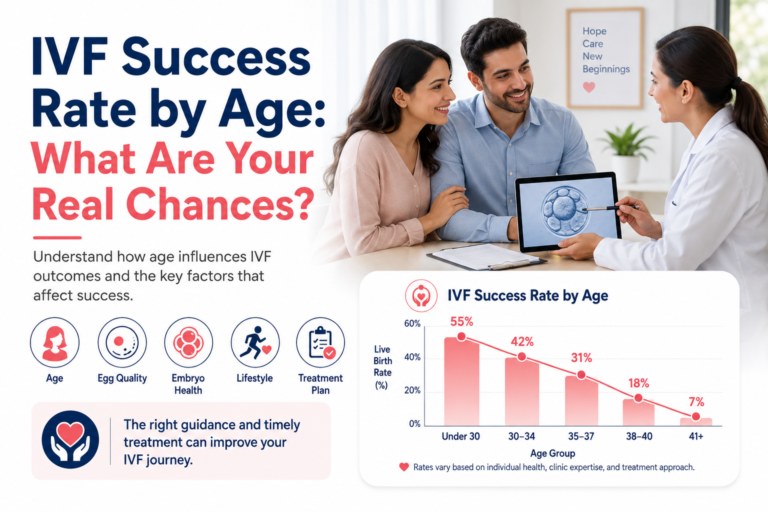
When couples come to us at Pune IVF, one question comes up in almost every first consultation: “What are my chances of success with IVF?” It’s the most natural question in the world — and you deserve an honest, clear answer rather than a marketing figure. The truth is that IVF success depends on several factors, but the single most important one is the woman’s age. In this guide, we explain realistic IVF success rates by age, what those numbers actually mean, and the steps that can genuinely improve your odds.
What does “IVF success rate” actually mean?
Before looking at numbers, it helps to understand what’s being measured, because clinics report success in different ways. A clinical pregnancy rate counts confirmed pregnancies (a heartbeat seen on ultrasound), while a live birth rate counts babies actually born. The live birth rate is always lower — and it’s the figure that truly matters, because the goal is a healthy baby in your arms, not just a positive test. Throughout this article, the ranges we quote lean towards live-birth outcomes, so you can plan with realistic expectations.
Why age matters most in IVF
A woman is born with all the eggs she will ever have, and both the number and the quality of those eggs decline with time — gradually through the late 20s and early 30s, and more sharply after 35. As egg quality falls, a higher proportion of embryos carry chromosomal abnormalities, which makes it harder for them to implant and more likely to result in early pregnancy loss. This is the biology behind every age-based success chart, and it’s why starting sooner generally means better odds.
IVF success rate by age
The table below shows typical per-cycle ranges in well-equipped Indian fertility centres, using a woman’s own eggs. These are general figures — your personal chances depend on your individual health and diagnosis.
Mother’s age | Approx. IVF success per cycle (own eggs) |
Under 35 | ~40–55% |
35–37 | ~30–45% |
38–40 | ~20–35% |
41–42 | ~12–20% |
Over 42 | Below ~10% |
As you can see, the decline is steady after 35 and steeper after 40. But these single-cycle numbers don’t tell the whole story.
First cycle vs cumulative success
Here’s something we always reassure our patients about: most women do not conceive on their very first IVF cycle, and that is not a failure. Among women under 35, roughly 30–40% of first cycles result in a live birth. The first cycle also gives your doctor invaluable information — how your ovaries respond, how many eggs are retrieved, and how your embryos develop — which is used to fine-tune the next attempt. Looked at across three cycles, the cumulative success rate for women under 35 rises to around 60–80%. IVF is often a journey of more than one step, and the cumulative picture is far more encouraging than any single number.
Donor eggs: changing the equation after 40
For women over 40 — especially those whose own eggs have not produced viable embryos — donor egg IVF can dramatically improve the odds. Because the eggs come from a younger, screened donor, success rates rise to around 50–70% regardless of the recipient’s age, since the limiting factor (egg quality) is removed. In India, egg donation is regulated under the ART (Regulation) Act, 2021, with strict donor screening and ethical safeguards — a framework we follow scrupulously at Pune IVF.
Beyond age: other factors that affect IVF success
While age is dominant, it isn’t the only factor. Success is also shaped by embryo quality, the quality of the IVF laboratory and the skill of the embryologists, uterine health, sperm quality, and lifestyle factors such as smoking, obesity, and stress. Underlying conditions like PCOS, endometriosis, and thyroid disorders also play a role. This is precisely why two women of the same age can have very different outcomes — and why an experienced clinic with a strong embryology lab makes a real difference.
How to improve your IVF success rate
Several things are genuinely within your control. Start as early as you can — time is the most precious variable in fertility. Adopt a healthy lifestyle: stop smoking, limit alcohol, maintain a healthy weight, eat well, and manage stress. Choose a clinic with a proven laboratory and experienced embryologists, since embryo handling is where many outcomes are decided. Where appropriate, techniques like blastocyst culture, single embryo transfer, and genetic screening of embryos (PGT-A) can improve the chances per transfer while keeping pregnancies safe.
A word on reading clinic “success rates”
Be a little cautious when comparing the headline success rates clinics advertise. A high number can be misleading if it counts pregnancies rather than live births, or if the clinic mainly treats younger, easier cases. The most useful question isn’t “What is this clinic’s overall success rate?” but rather “What are my chances, given my age and diagnosis?” — and a good fertility specialist will answer that honestly.
Your personalised chances at Pune IVF
Numbers on a chart are a starting point, not your destiny. At Pune IVF Fertility Centre, our specialists — led by Dr. Samidha Dalvi-Amale — assess your age, ovarian reserve, and overall health to give you a realistic, personalised picture, and a treatment plan designed around you. With centres in Pimple Saudagar, PCMC, Wakad, Hadapsar, Chikhali and Manchar, expert fertility care is close to home.
Frequently Asked Questions
On average, IVF success is around 30–40% per cycle, but it varies widely by age — from roughly 40–55% for women under 35 to under 10% for women over 42 using their own eggs.
It can, but most women don’t conceive on the first cycle, and that’s normal. Cumulative success over two or three cycles is much higher, reaching 60–80% for women under 35.
IVF tends to be most successful for women under 35, when egg quality and quantity are highest. Success declines gradually after 35 and more sharply after 40.
Yes, though success with your own eggs is lower after 40. Using donor eggs can raise success rates to 50–70% regardless of age.
Female age and egg quality are the biggest factors, followed by embryo quality, the laboratory’s standards, uterine health, sperm quality, and lifestyle.
It varies. Many couples succeed within one to three cycles. Each cycle also helps your doctor refine the next, improving your overall chances.
Yes. Not smoking, maintaining a healthy weight, eating well, and managing stress can all positively influence your chances.