
IVF Process Step by Step: What to Expect at Every Stage
Consult the Best IVF Specialists in Pune
Pune IVF Centre · Pimple Saudagar, Wakad, Hadapsar & Chikhali
For many couples, the decision to begin IVF comes with a mix of hope and nervousness — and a lot of unknowns. Understanding exactly what happens at each stage can take much of the fear out of the process. The good news is that IVF is a well-established, carefully monitored treatment, and most of it is far gentler than people expect. At Pune IVF, we guide every couple through the journey with clear explanations and support at each step. Here’s what the IVF process looks like, from start to finish.
What is IVF?
IVF (In Vitro Fertilisation) is a fertility treatment in which eggs are retrieved from the ovaries and fertilised with sperm in a specialised laboratory. The resulting embryo is then placed into the uterus, where it can implant and grow into a pregnancy. IVF is used for many causes of infertility, including blocked fallopian tubes, ovulation problems, male factor infertility, and unexplained infertility.
Before you begin: consultation and fertility testing
Every IVF journey starts with a thorough consultation and assessment. This includes reviewing your medical history, blood tests and hormone levels, an ultrasound to check the ovaries and uterus, and a semen analysis for the male partner. These tests help your specialist understand your specific situation and design a treatment plan tailored to you.
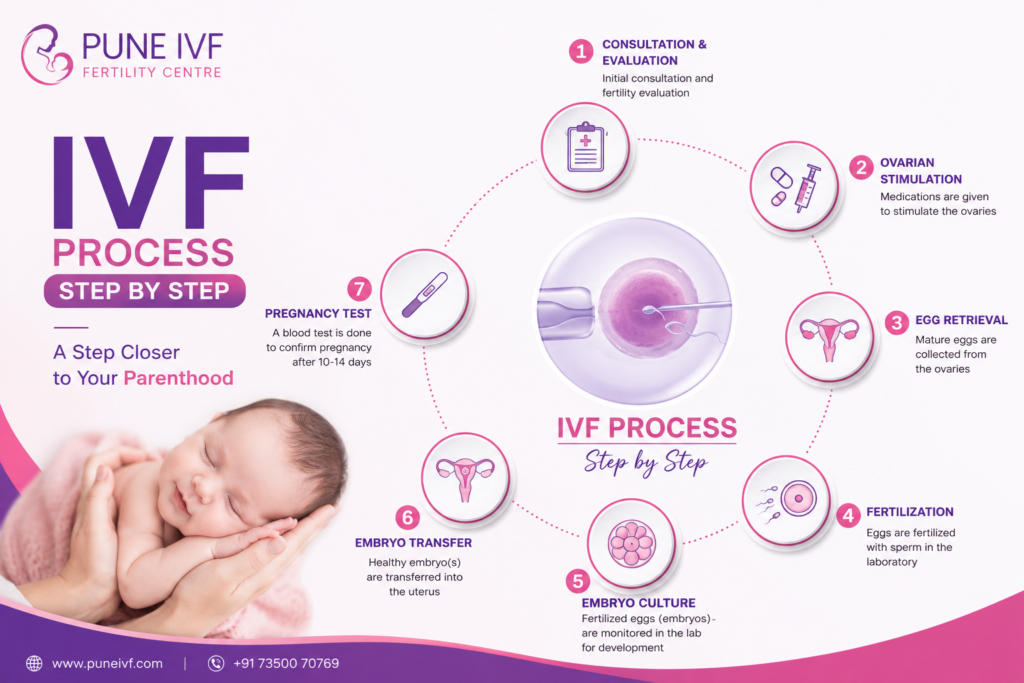
The IVF process: step by step
Step 1 — Ovarian stimulation. Normally, your body matures just one egg each month. In IVF, you take hormone injections for around 8–14 days to encourage the ovaries to grow several eggs at once, which increases the chances of creating healthy embryos.
Step 2 — Monitoring. During stimulation, you’ll have regular ultrasound scans and blood tests so your doctor can track how your follicles (the fluid-filled sacs that contain eggs) are developing and adjust your medication if needed.
Step 3 — The trigger shot. Once the follicles reach the right size, a final “trigger” injection is given to mature the eggs. This is precisely timed, because egg retrieval happens about 34–36 hours later.
Step 4 — Egg retrieval. This is a short procedure, usually around 20–30 minutes, performed under sedation so you won’t feel pain. Using ultrasound guidance, a fine needle gently collects the eggs from the ovaries. You’ll rest for a little while afterwards and can go home the same day.
Step 5 — Sperm collection. On the same day, a sperm sample is provided by the male partner (or retrieved surgically, or thawed from a frozen sample if needed). The sperm is then prepared in the lab.
Step 6 — Fertilisation in the lab. The eggs and sperm are brought together. In conventional IVF, they’re placed together in a dish; in ICSI, a single sperm is injected directly into each egg — a technique especially useful for male infertility. The embryologists then watch for signs of fertilisation.
Step 7 — Embryo culture. Over the next 3 to 5 days, the fertilised eggs grow into embryos in a carefully controlled incubator. By day 5, the strongest may reach the blastocyst stage, which often gives the best chance of implantation.
Step 8 — Embryo transfer. A healthy embryo is gently placed into the uterus using a thin, soft catheter. This step is quick, usually painless, and needs no anaesthesia — it feels much like a routine pelvic exam. Any good-quality extra embryos can be frozen for future use.
Step 9 — The two-week wait and pregnancy test. About 10–14 days after the transfer, a blood test confirms whether the embryo has implanted. This waiting period can feel emotionally intense, and our team is here to support you through it.
How long does the IVF process take?
A single IVF cycle — from the start of stimulation to the pregnancy test — typically takes around 4 to 6 weeks. The active, hands-on part is mostly concentrated into about two to three weeks of injections, scans, and the procedures themselves.
Is IVF painful?
This is one of the most common worries, and the reassuring answer is that IVF is generally not painful. The injections use very fine needles and cause only minor discomfort. Egg retrieval is done under sedation, so you feel nothing during it, and the embryo transfer is quick and painless. Some women experience mild bloating or cramping along the way, which is normal and temporary.
What happens to extra embryos?
If you have more good-quality embryos than are transferred, they can be frozen (cryopreserved) for the future. This means that if a cycle isn’t successful, or if you’d like another child later, a frozen embryo transfer (FET) can be done without repeating the full stimulation and retrieval process.
After the IVF cycle: what’s next
If the test is positive, your pregnancy will be monitored closely in the early weeks before you transition to regular antenatal care. If it isn’t successful, please remember this is common and not a failure — your doctor will review what happened, and that information is used to improve your next cycle. Many couples succeed with a frozen transfer or a subsequent attempt.
Begin your IVF journey at Pune IVF
Every step of IVF is a step taken with expert hands and genuine care. At Pune IVF Fertility Centre, led by Dr. Samidha Dalvi-Amale, our experienced specialists and embryologists guide you through the entire process with clarity, compassion, and advanced laboratory care. With centres across Pimple Saudagar, PCMC, Wakad, Hadapsar, Chikhali and Manchar, your journey to parenthood is closer than you think.
Frequently Asked Questions
A full IVF cycle usually takes about 4 to 6 weeks, from the start of ovarian stimulation to the pregnancy test, with the most active phase lasting two to three weeks.
IVF is generally not painful. Injections cause only minor discomfort, egg retrieval is done under sedation, and embryo transfer is quick and painless.
Hormone injections are typically given daily for around 8–14 days during the stimulation phase, followed by a single trigger shot before egg retrieval.
In conventional IVF, eggs and sperm are combined in a dish. In ICSI, a single sperm is injected directly into each egg — particularly helpful for male infertility.
Success depends on factors like the woman’s age and embryo quality. Transferring a healthy blastocyst-stage embryo generally offers the best chance of implantation.
It’s the roughly 10–14 day period between embryo transfer and the pregnancy blood test, when the embryo may implant. It can be emotionally challenging, so support matters.
Yes. Good-quality extra embryos can be frozen for future use, allowing a simpler frozen embryo transfer later without repeating the full cycle.
A failed cycle is common and not a reason to lose hope. Your doctor reviews the cycle to refine the next attempt, and many couples succeed on a later try or with a frozen transfer.