
Consult the Best IVF Specialists in Pune
Pune IVF Centre · Pimple Saudagar, Wakad, Hadapsar & Chikhali
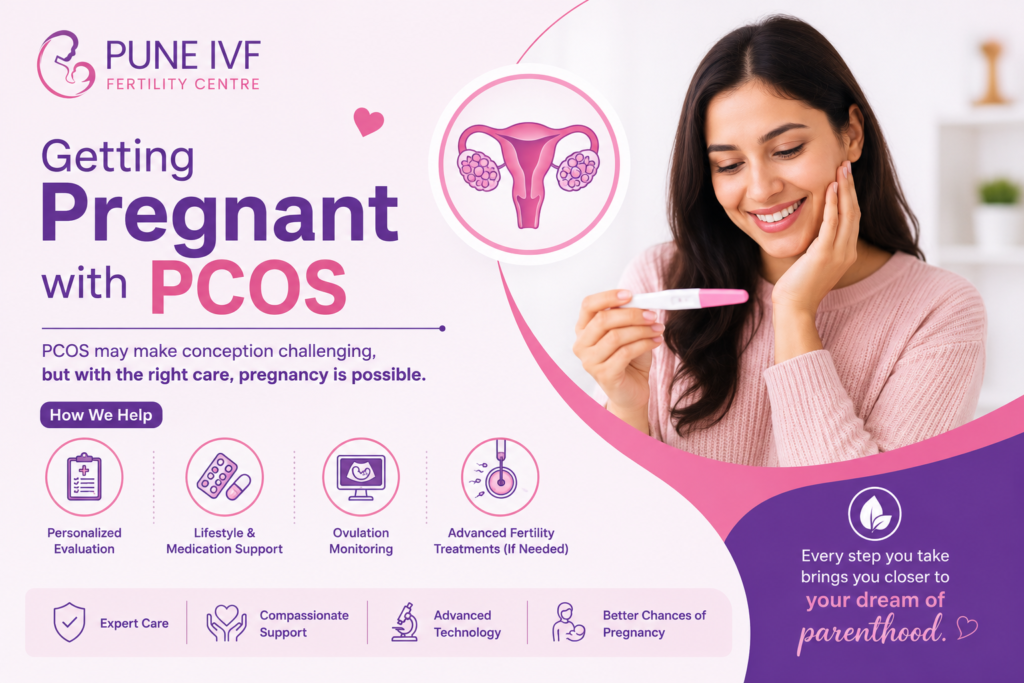
For many women, being diagnosed with PCOS brings an immediate, anxious question: “Will I ever be able to have a baby?” If that’s where your mind has gone, we want to reassure you right away — PCOS is the most common cause of infertility in women, but it’s also one of the most treatable. The vast majority of women with PCOS can and do become pregnant, whether naturally, with simple medication, or with the support of fertility treatment. At Pune IVF, we help women with PCOS conceive every day. This guide explains how PCOS affects fertility and the proven steps to help you get pregnant.
What is PCOS?
PCOS (Polycystic Ovary Syndrome) is a hormonal and metabolic condition affecting women of reproductive age — roughly one in five Indian women. In PCOS, the ovaries produce higher-than-normal levels of male hormones (androgens), which disrupts the regular release of eggs and can cause several small follicles to develop on the ovaries. The most familiar signs are irregular periods, weight gain, acne, and excess hair growth.
How does PCOS affect fertility?
The heart of the issue is ovulation. To conceive naturally, an egg must mature and be released each month. In PCOS, the hormonal imbalance — often driven by insulin resistance and excess androgens — means eggs frequently don’t mature or release on a regular schedule. This is called irregular or absent ovulation (anovulation). Quite simply, if an egg isn’t released, there’s nothing for the sperm to fertilise, which is why conceiving can take longer. This is exactly why irregular or missed periods are such an important clue.
Can you get pregnant with PCOS?
Yes — and this is the most important message of this article. PCOS affects ovulation, and ovulation is something that can very often be restored. Many women with PCOS conceive naturally once they make a few changes; others need gentle medication to encourage ovulation; and some benefit from treatments like IUI or IVF. The key is not to lose hope, and not to wait too long before seeking guidance.
How is PCOS-related infertility diagnosed?
At Pune IVF, we begin by building a clear picture of your fertility. This includes a review of your menstrual history, blood tests to check hormone levels, thyroid function, and markers of insulin resistance and ovarian reserve, and an ultrasound to examine your ovaries and uterus. Importantly, we also assess for other fertility factors — because PCOS can coexist with other issues, we evaluate both partners, including a semen analysis for your partner. A complete picture lets us recommend the simplest treatment that will work for you.
Step 1 — Lifestyle changes and weight management
For most women with PCOS, the first and most powerful step is lifestyle. Because insulin resistance is so central to PCOS, improving it can naturally restore ovulation. Even a modest amount of weight loss — often around 5% of body weight — can be enough to bring back regular cycles and significantly improve the chances of conception. A balanced diet that’s lower in refined carbohydrates and sugar, regular physical activity, good sleep, and stress management form the foundation. Even for women in a healthy weight range, these habits improve insulin sensitivity and support fertility.
Step 2 — Ovulation induction medication
When lifestyle changes alone aren’t enough, the next step is usually ovulation induction — gentle medication that helps the ovaries release an egg. Letrozole is now widely used as the first-choice medication for PCOS, because it effectively stimulates ovulation while keeping the risk of twins or triplets low. Clomiphene citrate is another well-established option. For women with significant insulin resistance, metformin is sometimes added to improve the response. Treatment is carefully monitored with ultrasound to track how your follicles develop and to time things correctly.
Step 3 — IUI (Intrauterine Insemination)
For some couples, ovulation induction is combined with IUI, in which prepared sperm is placed directly into the uterus around the time of ovulation. This is a simple, minimally invasive treatment that can be helpful when there’s a mild male factor, unexplained difficulty, or timing challenges alongside PCOS.
Step 4 — IVF for PCOS
If ovulation induction and IUI don’t lead to pregnancy, or if there are additional fertility factors, IVF is a highly effective option. Women with PCOS often respond very well to IVF and produce a good number of eggs — which is an advantage. Because of this strong response, our specialists monitor PCOS patients especially carefully to keep treatment safe and avoid a condition called ovarian hyperstimulation (OHSS). With expert handling, IVF offers women with PCOS excellent chances of success.
PCOS pregnancy: what to expect
It’s worth knowing that pregnancies in women with PCOS carry a slightly higher risk of gestational diabetes, high blood pressure, and early miscarriage. This isn’t a cause for worry so much as a reason for good care — with appropriate monitoring throughout pregnancy, the great majority of women with PCOS go on to have healthy pregnancies and healthy babies. Early, attentive antenatal care makes all the difference.
Boosting your fertility with PCOS
Alongside medical treatment, a few habits genuinely help: maintain a healthy weight, follow a balanced low-sugar diet, stay physically active, manage stress and sleep well, avoid smoking and excess alcohol, and start a folic acid supplement when you’re trying to conceive. That said, if your periods are very irregular or absent, please don’t rely on natural methods alone for too long — irregular ovulation means fewer natural chances each year, so timely expert help is the wisest path.
When should you see a fertility specialist?
A good rule is to seek help after 12 months of trying without success — or after 6 months if you’re over 35. But with PCOS, there’s an important exception: if your cycles are very irregular or you rarely get a period, it’s sensible to consult a specialist sooner, because you may not be ovulating regularly on your own. Early evaluation simply gives you more time and more options.
Your PCOS fertility journey at Pune IVF
PCOS doesn’t have to stand between you and motherhood. At Pune IVF Fertility Centre, led by Dr. Samidha Dalvi-Amale, we specialise in helping women with PCOS conceive — guiding you from lifestyle support and ovulation induction to IUI and IVF, with care that’s personal, patient, and judgement-free. With centres in Pimple Saudagar, PCMC, Wakad, Hadapsar, Chikhali and Manchar, expert fertility care is close to home.
Frequently Asked Questions
Yes, many women with PCOS conceive naturally, especially after lifestyle changes that help restore regular ovulation. Others may need medication to ovulate.
Treatment usually starts with lifestyle and weight management, followed by ovulation induction medication such as letrozole. IUI or IVF are used if needed.
No. PCOS is the most common cause of female infertility, but it’s also one of the most treatable. It mainly affects ovulation, which can usually be restored.
Weight loss improves insulin resistance, which is central to PCOS. Even a modest 5% reduction can restore regular ovulation and improve your chances of conceiving.
Not usually. Most women with PCOS conceive with lifestyle changes, ovulation medication, or IUI. IVF is considered when these don’t succeed or other fertility factors are present.
PCOS slightly raises the risk of gestational diabetes, high blood pressure, and miscarriage, so good antenatal monitoring is important. With proper care, most pregnancies are healthy.
It varies. Some women conceive within months of starting treatment; others take longer. Restoring regular ovulation is the key factor, and a specialist can speed this up.
Metformin can help by improving insulin resistance and supporting ovulation, and is sometimes combined with ovulation-inducing medication. Your specialist will advise if it’s right for you.